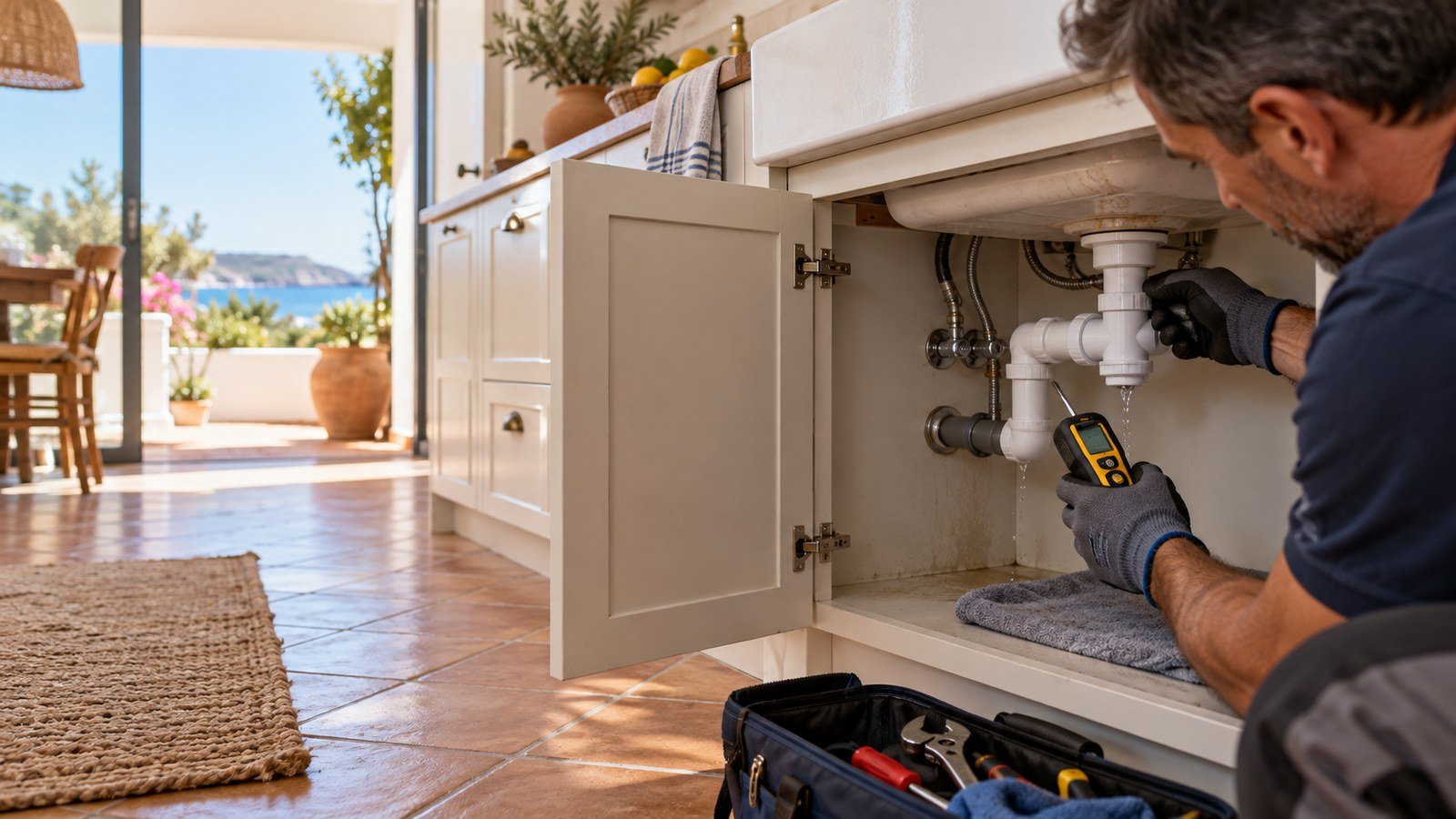
Water Leak or Burst Pipe in the Algarve? What to Do First and How to Find a Plumber
What to do in the first hour, how to spot a hidden leak, who pays for the lost water, what insurance usually covers and how to hire a plumber you can trust.
The short answer: stop the water at the main valve, usually next to the water meter (contador). Keep water away from electrics, take photos and video, then call your home insurer's assistance line before booking a plumber, because many policies have their own emergency service. Anything leaking after the meter is normally the owner's responsibility, so the faster you act, the less you pay for lost water and damage.
Most people only search for a plumber when something has already gone wrong: water coming through a ceiling, a damp patch spreading across a tiled floor, or a water bill that is double what it should be. In the Algarve there are a few local twists that catch owners out, from pipes buried in concrete to holiday homes that sit empty for weeks while a slow leak runs.
This guide covers what to do immediately, how to find hidden leaks, who pays, how insurance usually works and how to choose a plumber without regretting it. For background on how plumbing works in an Algarve home, including water heaters and septic tanks, see our page on plumbers in the Algarve.
The first 30 minutes after a leak
- Stop the water. Close the main valve. In most houses it sits beside the water meter, often in a box in a boundary wall, in the garage or under the kitchen sink. In apartments it may be in a cupboard on the landing. Find yours now, before you need it.
- Make the electrics safe. If water is near sockets, lights or the consumer unit (quadro elétrico), switch off the affected circuits or the main switch, provided you can reach it without standing in water.
- Turn off the water heater. Switch off an electric termoacumulador, and turn off the gas to an esquentador or boiler if the leak is near it.
- Record everything. Take photos and video of the water, the damage and the area around it before you clean up. Your insurer will want them.
- Limit the spread. Move furniture and rugs, mop up and use towels and buckets. Open windows to start drying.
- Tell the neighbours. In an apartment, warn the people below and the condominium administrator. Water travels, and fast warnings prevent arguments later.
- Call your insurer's assistance line. Many home policies include an emergency plumber or leak detection service. Using it can save money and avoids disputes about who you hired.
Signs of a hidden leak
Pipes in Algarve homes are often buried in concrete floors and walls, so leaks can run for months unseen. Watch for:
- A water bill that rises with no change in how you use water
- A pressure pump that clicks on at night when nobody is using water
- Damp patches, bubbling paint or mould low on walls
- Floor tiles that feel loose or sound hollow when tapped
- The sound of running water when everything is off
- Low water pressure that comes and goes
The meter test
Turn off every tap, the washing machine, the dishwasher, the irrigation system and anything else that uses water. Check that toilets have stopped filling. Note the reading on the water meter, or watch its small dial, for 20 to 30 minutes. If it moves, water is escaping somewhere after the meter. Then close the valve to the garden or pool, if there is one, and test again to narrow down where the leak is.
Irrigation systems and pool supplies are common culprits in the Algarve, and they are easy to forget because the leak is underground and outside.
Holiday homes and empty properties
A slow leak in an empty house is one of the most expensive problems an Algarve owner can have. Nobody sees the damp patch, the pump runs day and night and the damage spreads until the next visit.
- Close the main water valve every time you leave, unless the garden irrigation or pool genuinely needs it, and if so, isolate the house supply.
- Give a key holder clear instructions and the location of the valve and the consumer unit.
- Read your insurance policy for conditions about unoccupied periods. Some policies limit cover if a home is empty for a set number of days.
- Consider leak sensors or an automatic shut off valve, which can alert your phone or close the supply when water is detected.
- Ask your water supplier whether you can see your consumption online, so an unusual jump stands out quickly.
Who pays for the lost water
In Portugal, the water supply connection up to the property boundary is the water supplier's responsibility. The pipes and fittings inside your property, after the meter, are the owner's responsibility to maintain. Water recorded by the meter is generally included in the customer’s bill, but responsibility can depend on the location of the leak, the property arrangement and the local supplier’s rules.
Portuguese water-service rules may provide an adjustment in some proven leak cases, but the calculation and eligibility are administered under the applicable regulation and supplier procedures. Contact the local supplier promptly, ask what evidence and deadlines apply, and keep the plumber’s invoice and repair report. Do not assume an adjustment will be granted.
In apartment buildings, pipes that serve more than one flat are usually the condominium's responsibility, while pipes serving only your flat are yours. Check the building rules and speak to the administrator early.
What home insurance usually covers
Many Portuguese home policies (seguro multirriscos habitação) offer a water-damage cover called danos por água, but cover varies by insurer and contract. Check your own policy wording and ask the insurer before arranging non-urgent work. As a general guide:
- Usually covered: sudden bursts and overflows from internal pipes, and leaks from heating or air conditioning systems.
- Sometimes covered: the cost of finding the leak, often called pesquisa de avarias. Some insurers send their own technicians who use methods that avoid opening walls unnecessarily.
- Usually excluded: slow infiltration through roofs, terraces and walls, poorly sealed baths and showers, damp and condensation, and damage from lack of maintenance.
A claim can be affected by exclusions, maintenance history, the cause and how long the leak was present. Report leaks promptly, keep your photos and check your excess (franquia) and policy wording before deciding how to proceed.
Water heaters, limescale and gas
Water in much of the Algarve is hard, so limescale builds up in heaters, valves, taps and shower heads. A leaking pressure valve on a termoacumulador is often a sign of scale or a valve at the end of its life rather than a burst pipe. Regular servicing is cheaper than an emergency call.
Gas is different. Installing, adapting, repairing or maintaining gas appliances such as an esquentador is work for gas professionals recognised by DGEG, the national energy authority, working through an authorised gas installation company. A plumber who is not qualified for gas should not touch it. Ask to see their DGEG identification before any gas work. If you smell gas, leave the property and call your gas supplier's emergency line or 112.
How to hire a plumber quickly without regretting it
Urgency is exactly when people skip the checks. A few minutes of questions on the phone makes a big difference.
What to tell the plumber
- Your location and type of property: villa, townhouse or apartment
- What you see, with photos or a short video sent by WhatsApp
- What you have already done, such as closing the valve or switching off the heater
- Whether there is a pool, irrigation, solar panels or a septic tank (fossa séptica)
What to ask before they come
- What is the call out charge, and does it include the first hour?
- How will you find the leak? Good options include pressure testing, moisture readings, thermal cameras and acoustic detection, rather than breaking open walls on a guess.
- Who repairs the tiles or plaster afterwards, and is that in the price?
- Will I get a proper invoice with my NIF on it?
- Do you carry insurance for the work?
For larger repair jobs
If the repair turns into a bigger job, such as replacing pipework or a bathroom, get a written quotation that separates labour and materials. Repair and renovation works on housing can qualify for 6% VAT on the labour instead of 23%, under a works contract and when materials stay within 20% of the total. If materials go above that, they should be shown separately at the standard rate. Ask the plumber which rate applies and why. Our free quote comparison tool helps you compare quotations line by line, and our guide on finding a reliable builder in Portugal covers contracts and staged payments for larger works.
Warning signs
- Breaking open walls or floors before any attempt to locate the leak
- Refusing to give a call out price or an hourly rate
- No invoice, or an invoice in a different name from the business you called
- Offering to work on a gas appliance without gas qualifications
- Pressure to replace a whole system when one part has failed, without explaining why
- Leaving without making the area safe or explaining what was found
Finding a plumber in the Algarve
Save the details of a plumber before you need one. It is much easier to check someone properly on a calm day than at midnight with water on the floor. You can browse plumbers by area on our pages for Lagos, Portimão, Albufeira, Faro and Tavira, or search the full Algarve trades directory.
Leaks often leave damage behind, so you may also need tilers, plasterers or bathroom fitters to put things right. If water is coming in from above rather than from a pipe, start with roofers. A listing is a starting point, not a guarantee, so still ask the questions above and keep everything in writing.
Frequently asked questions
Who pays for a water leak after the meter in Portugal?
The pipes and fittings inside your property, after the water meter, are generally the owner's responsibility to maintain, and metered water lost through a leak is normally billed to the customer. The water supplier is responsible for the connection pipe up to the property boundary. If a leak inside your property is proven, ask your supplier about a billing correction under the national water services regulation.
Does home insurance in Portugal cover water leaks?
Most multirriscos habitação policies with water damage cover (danos por água) include sudden bursts and overflows from internal pipes. Slow leaks, infiltration through roofs and walls, condensation and wear from lack of maintenance are commonly excluded. Some policies also pay to find the leak. Check your own policy wording and excess.
How can I tell if I have a hidden water leak?
Turn off every tap and appliance that uses water, then watch the water meter for 20 to 30 minutes. If the small dial or the last digits keep moving, water is escaping somewhere. Other signs are a pressure pump running at night, damp patches, loose or hollow tiles, mould and a bill that rises with no change in use.
Can any plumber work on a gas water heater in Portugal?
No. Installing, adapting, repairing and maintaining gas appliances such as an esquentador is work for gas professionals recognised by DGEG, the Portuguese energy authority. Ask to see their DGEG identification before any gas work starts.
Sources
- ERSAR, the Portuguese water and waste services regulator
- NOVA Consumer Lab: water supply and leaks in the property network
- DGEG: gas professionals
- Allianz Portugal: water damage in home insurance
- DECO PROteste: when 6% VAT applies to works
Need a plumber in the Algarve?
Browse local trades, compare services and coverage, and check verification details before you choose.
Find a plumberList your business